Saturday, December 18, 2010

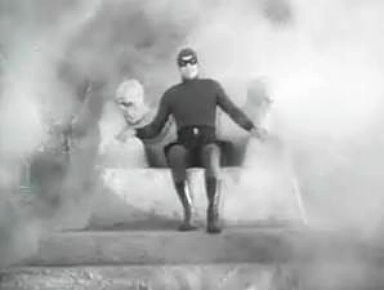
Serial Saturday Part 4: Batman and Robin (1949)****


The first serial featuring the Caped Crusader, 1943’s Batman, was produced at the height of the frenzied zeitgeist of WWII, and featured an array of Japanese villains (white actors pretending to be Japanese, to be precise) and some appalling racially-charged dialogue. That serial is not suitable for children and is barely passable for adults, unless you like wall-to-wall epithets and ill-fitting costumes.


Batman and Robin from 1949 was the second cinematic incarnation, but the first in our Serial Saturday series to feature truly modern production quality and a decent print to boot. The shots are in focus and properly exposed (I know this doesn’t sound too exciting, but the older serials have some really crappy technicals) and the soundtrack is clear, strong and thankfully free of the scratchy noises and distortions that marred the Mascot productions of the 1930s.


Batman is played by Robert Lowery, a 36 year old journeyman actor with an extensive record of film industry employment in westerns and crime dramas. Lowery’s good looks and smooth vocal delivery kept him busy as a supporting actor but the rank of elite leading man would elude him throughout his career. Lowery does a good job here of portraying alter-ego Bruce Wayne as a pampered waste of air, while imbuing the Dark Knight with an imposing toughness, despite his silly couture.


Taciturn John Duncan, as the Boy Wonder, is a welcome break from the cocky, self indulgent Robins of more recent vintage. Duncan’s still waters run very deep, and while his line readings don’t exactly sparkle, he exudes a steely focus on the task at hand. I’d much rather go into battle with this Dick Grayson than the brash, mouthy Robins of Burt Ward and Chris O’Donnell.


In this 4 ½ hour opus, Gotham City faces impending doom at the hands of a mysterious cloaked figure known as The Wizard. He and his band of sharp-dressed henchmen have stolen a top secret invention that’s essentially the world’s largest remote control. With it, the Wizard can commandeer any plane, train or automobile within a hundred miles, and use that vehicle to unleash wanton death and destruction. Well, he can ram a car into a tree anyway, which was about all the mayhem this low budget serial would allow.


In Chapter One, our heroes leap to the Batmobile - actually in this production it’s a stock 1949 Mercury convertible – in hot pursuit of an armored car under the Wizard’s influence. While the Dynamic Duo is able to thwart the Wizard’s nefarious scheme on this occasion, it becomes clear that, as is often the case in serials, finally slapping the cuffs on this slippery perp will be a long, drawn-out affair.


Just getting to the Wizard’s hideout is an exercise in patience. First, his henchmen have to go to an isolated location at the shore and find the exact right bush to move out the way, revealing a narrow tunnel that descends to a secret underground marina. From there, a submarine shuttles the men to an island where the Wizard scans them with a fancy version of x-ray goggles. If the visitors pass muster, the Wizard pushes a button and allows the men entry into his secret lair of buzzing contraptions and brightly flashing gizmos.


Visiting the Wizard requires a concerted effort. And after you do all that he doesn’t even offer you a cuppa. Hardly seems worth it. Anyway, this cumbersome ritual is repeated many times throughout the serial – I suppose it was one way to extend the episodes to proper length - and eventually the viewer wishes the Wizard would just move someplace closer to town; perhaps a nice condo, convenient to schools and shopping.


And speaking of town, the Gotham City depicted here is not the hotbed of foreboding art-deco skyscrapers as envisioned by Tim Burton and Chris Nolan, but rather a flat, sleepy burg - as exciting and energetic as Akron on a Sunday morning. Street scenes are filmed on back lots with absolutely no effort expended on atmospherics – no strolling extras, no passing cars – creating the sense that the city’s entire population suffers from pathological shyness. Car chases, and there are a lot of them, are filmed in rural areas on dirt roads. Unfortunately, the speeding vehicles create huge dust clouds that partially obscure our view of Gotham’s finest cabbage patches.


The cheapness extends to the Batmobile itself. In fact, there isn’t one. Here, Bruce Wayne’s personal vehicle must suffice as the Dark Knight’s ride. When the top is down, the Mercury conveys Bruce and Dick to their frivolous idle rich appointments. When the top is up, the Dynamic Duo is hot on the trail of the dastardly Wizard. This subtle subterfuge does not fool the very sharp and shapely Vicky Vale (Jane Adams), who finally asks the burning question “What are you doing with Bruce Wayne’s car, Batman?” This query stumped even the writers, as the Caped Crusader just kind of shrugs and laughs it off.


However, these same writers did create one clever deus ex machina; the Wizard’s terrifying device requires bearings made from very expensive diamonds to perform even the most rudimentary functions. So before he can destroy the world, his henchmen must knock off every Zale’s and Jared’s in Gotham, giving Batman and Robin an all-you-can-eat buffet of misdeeds to investigate and thwart. And that, my friends, is how you get a serial to last 263 minutes.


With the advent of the fourth hour, after the Caped Crusaders have survived raging infernos, falls from high rooftops, out of control airplanes and assorted other perils, the serial begins to chug toward conclusion. And by then most viewers, along with the Dynamic Duo, will have thoroughly had it with The Wizard and his shit.


But there is one more revelation to be made - the discovery of the Wizard’s identity – and while it’s a complete surprise, it also is a bit of a letdown. But through this discovery, our heroes are able to finally to corner the devilish criminal. The actual apprehension is surprisingly laid-back and routine, kind of like the collaring of Al Capone for faulty IRS reporting.


You’re probably thinking that after such a litany of complaints, your loyal but snotty reviewer hated Batman and Robin. Nothing could be further from the truth. In fact, I adored it. As a Batman completist, any manifestation of the character interests me, as long as it remains somewhat true to the legend. My least favorite Batman film, 2008’s The Dark Knight, took too many liberties for my taste, wasn’t much fun and was filmed in such inky darkness it was often incoherent.


This serial succeeds due to the actors. Not necessarily the acting, which barely rises above serviceable, but the attitudes of the performers themselves. From Lowery’s Batman to the lowliest henchman day-player, the cast went about their roles with earnest, absolute conviction.


There’s no tongue-in-cheek smugness and no sense that the actors felt the script was beneath them. Instead, there’s an admirable resolution to interpret every character and each line of dialogue with an unshakable commitment to believability; the cheesy sets and hokey costumes be damned. Rarely is “work ethic” used as a reason to recommend a movie, but this lunch pail, blue collar version of Batman and Robin, devoid of irony and camp, is downright refreshing.


Serial Saturday Part 4: Batman and Robin (1949)****


The first serial featuring the Caped Crusader, 1943’s Batman, was produced at the height of the frenzied zeitgeist of WWII, and featured an array of Japanese villains (white actors pretending to be Japanese, to be precise) and some appalling racially-charged dialogue. That serial is not suitable for children and is barely passable for adults, unless you like wall-to-wall epithets and ill-fitting costumes.


Batman and Robin from 1949 was the second cinematic incarnation, but the first in our Serial Saturday series to feature truly modern production quality and a decent print to boot. The shots are in focus and properly exposed (I know this doesn’t sound too exciting, but the older serials have some really crappy technicals) and the soundtrack is clear, strong and thankfully free of the scratchy noises and distortions that marred the Mascot productions of the 1930s.


Batman is played by Robert Lowery, a 36 year old journeyman actor with an extensive record of film industry employment in westerns and crime dramas. Lowery’s good looks and smooth vocal delivery kept him busy as a supporting actor but the rank of elite leading man would elude him throughout his career. Lowery does a good job here of portraying alter-ego Bruce Wayne as a pampered waste of air, while imbuing the Dark Knight with an imposing toughness, despite his silly couture.


Taciturn John Duncan, as the Boy Wonder, is a welcome break from the cocky, self indulgent Robins of more recent vintage. Duncan’s still waters run very deep, and while his line readings don’t exactly sparkle, he exudes a steely focus on the task at hand. I’d much rather go into battle with this Dick Grayson than the brash, mouthy Robins of Burt Ward and Chris O’Donnell.


In this 4 ½ hour opus, Gotham City faces impending doom at the hands of a mysterious cloaked figure known as The Wizard. He and his band of sharp-dressed henchmen have stolen a top secret invention that’s essentially the world’s largest remote control. With it, the Wizard can commandeer any plane, train or automobile within a hundred miles, and use that vehicle to unleash wanton death and destruction. Well, he can ram a car into a tree anyway, which was about all the mayhem this low budget serial would allow.


In Chapter One, our heroes leap to the Batmobile - actually in this production it’s a stock 1949 Mercury convertible – in hot pursuit of an armored car under the Wizard’s influence. While the Dynamic Duo is able to thwart the Wizard’s nefarious scheme on this occasion, it becomes clear that, as is often the case in serials, finally slapping the cuffs on this slippery perp will be a long, drawn-out affair.


Just getting to the Wizard’s hideout is an exercise in patience. First, his henchmen have to go to an isolated location at the shore and find the exact right bush to move out the way, revealing a narrow tunnel that descends to a secret underground marina. From there, a submarine shuttles the men to an island where the Wizard scans them with a fancy version of x-ray goggles. If the visitors pass muster, the Wizard pushes a button and allows the men entry into his secret lair of buzzing contraptions and brightly flashing gizmos.


Visiting the Wizard requires a concerted effort. And after you do all that he doesn’t even offer you a cuppa. Hardly seems worth it. Anyway, this cumbersome ritual is repeated many times throughout the serial – I suppose it was one way to extend the episodes to proper length - and eventually the viewer wishes the Wizard would just move someplace closer to town; perhaps a nice condo, convenient to schools and shopping.


And speaking of town, the Gotham City depicted here is not the hotbed of foreboding art-deco skyscrapers as envisioned by Tim Burton and Chris Nolan, but rather a flat, sleepy burg - as exciting and energetic as Akron on a Sunday morning. Street scenes are filmed on back lots with absolutely no effort expended on atmospherics – no strolling extras, no passing cars – creating the sense that the city’s entire population suffers from pathological shyness. Car chases, and there are a lot of them, are filmed in rural areas on dirt roads. Unfortunately, the speeding vehicles create huge dust clouds that partially obscure our view of Gotham’s finest cabbage patches.


The cheapness extends to the Batmobile itself. In fact, there isn’t one. Here, Bruce Wayne’s personal vehicle must suffice as the Dark Knight’s ride. When the top is down, the Mercury conveys Bruce and Dick to their frivolous idle rich appointments. When the top is up, the Dynamic Duo is hot on the trail of the dastardly Wizard. This subtle subterfuge does not fool the very sharp and shapely Vicky Vale (Jane Adams), who finally asks the burning question “What are you doing with Bruce Wayne’s car, Batman?” This query stumped even the writers, as the Caped Crusader just kind of shrugs and laughs it off.


However, these same writers did create one clever deus ex machina; the Wizard’s terrifying device requires bearings made from very expensive diamonds to perform even the most rudimentary functions. So before he can destroy the world, his henchmen must knock off every Zale’s and Jared’s in Gotham, giving Batman and Robin an all-you-can-eat buffet of misdeeds to investigate and thwart. And that, my friends, is how you get a serial to last 263 minutes.


With the advent of the fourth hour, after the Caped Crusaders have survived raging infernos, falls from high rooftops, out of control airplanes and assorted other perils, the serial begins to chug toward conclusion. And by then most viewers, along with the Dynamic Duo, will have thoroughly had it with The Wizard and his shit.


But there is one more revelation to be made - the discovery of the Wizard’s identity – and while it’s a complete surprise, it also is a bit of a letdown. But through this discovery, our heroes are able to finally to corner the devilish criminal. The actual apprehension is surprisingly laid-back and routine, kind of like the collaring of Al Capone for faulty IRS reporting.


You’re probably thinking that after such a litany of complaints, your loyal but snotty reviewer hated Batman and Robin. Nothing could be further from the truth. In fact, I adored it. As a Batman completist, any manifestation of the character interests me, as long as it remains somewhat true to the legend. My least favorite Batman film, 2008’s The Dark Knight, took too many liberties for my taste, wasn’t much fun and was filmed in such inky darkness it was often incoherent.


This serial succeeds due to the actors. Not necessarily the acting, which barely rises above serviceable, but the attitudes of the performers themselves. From Lowery’s Batman to the lowliest henchman day-player, the cast went about their roles with earnest, absolute conviction.


There’s no tongue-in-cheek smugness and no sense that the actors felt the script was beneath them. Instead, there’s an admirable resolution to interpret every character and each line of dialogue with an unshakable commitment to believability; the cheesy sets and hokey costumes be damned. Rarely is “work ethic” used as a reason to recommend a movie, but this lunch pail, blue collar version of Batman and Robin, devoid of irony and camp, is downright refreshing.


Wednesday, December 15, 2010

Before the Rains (2007)***


Before The Rains is an entertaining, if fleeting, epic of colonial India and by the time you drop it in the return mail, you will have forgotten all about it. Linus Roche stars as an uptight British plantation owner named Moores. He and his loyal foreman T.J. (Rahul Bose) hatch an ambitious scheme to plant acres of tea and spices, all while building a monsoon-proof mountain road over rugged terrain.


As if that weren’t enough to keep Moores busy, he also finds time to diddle his beautiful Indian housekeeper Sajani (Nandita Das), a rustic villager who takes Moores’ attentions quite seriously and serves him her heart and soul along with the vindaloo. All is peachy in Moores’ selfish paradise until one day when his wife and child return to the plantation from an extended visit to England, and find not only oppressive humidity, but a series of odd occurrences, as Moores and T.J. attempt to keep Sajani’s expectations and emotions in check.


We learn much about the depressing existence led by young women in tribal areas of India during that time, and how the Anglo concept of free will was as foreign and unknown as space travel. And it is clear that Moores’ arrogant ignorance of tribal customs has caused his harmless little affair to morph into a tide of anger and destruction that threatens to wash away his dreams like a monsoon flood.


Director Santosh Sivan has worked primarily as a cinematographer for much of his career, as is evidenced by the film’s sweeping mountain panoramas and beautiful candle-lit interior scenes. But the splendid visuals are not quite enough to elevate this film beyond the ordinary, as the script has a shortage of profound moments, not to mention a few holes. In all, the acting is quite good, especially Bose and Jennifer Ehle as Mrs. Moores. While the film features many betrayals, the first, and most damaging, is the script itself.


Before the Rains (2007)***


Before The Rains is an entertaining, if fleeting, epic of colonial India and by the time you drop it in the return mail, you will have forgotten all about it. Linus Roche stars as an uptight British plantation owner named Moores. He and his loyal foreman T.J. (Rahul Bose) hatch an ambitious scheme to plant acres of tea and spices, all while building a monsoon-proof mountain road over rugged terrain.


As if that weren’t enough to keep Moores busy, he also finds time to diddle his beautiful Indian housekeeper Sajani (Nandita Das), a rustic villager who takes Moores’ attentions quite seriously and serves him her heart and soul along with the vindaloo. All is peachy in Moores’ selfish paradise until one day when his wife and child return to the plantation from an extended visit to England, and find not only oppressive humidity, but a series of odd occurrences, as Moores and T.J. attempt to keep Sajani’s expectations and emotions in check.


We learn much about the depressing existence led by young women in tribal areas of India during that time, and how the Anglo concept of free will was as foreign and unknown as space travel. And it is clear that Moores’ arrogant ignorance of tribal customs has caused his harmless little affair to morph into a tide of anger and destruction that threatens to wash away his dreams like a monsoon flood.


Director Santosh Sivan has worked primarily as a cinematographer for much of his career, as is evidenced by the film’s sweeping mountain panoramas and beautiful candle-lit interior scenes. But the splendid visuals are not quite enough to elevate this film beyond the ordinary, as the script has a shortage of profound moments, not to mention a few holes. In all, the acting is quite good, especially Bose and Jennifer Ehle as Mrs. Moores. While the film features many betrayals, the first, and most damaging, is the script itself.


Saturday, December 11, 2010

Serial Saturday Part 3: The Phantom (1943)**


Lee Falk’s The Phantom, created in 1936, was a precursor of the modern superhero concept. Essentially a hybrid of the Lone Ranger and Tarzan, The Phantom pioneered many pulp innovations, including the skin-tight union suits that have become the garment of choice for today’s battery of masked crime fighters. The Phantom’s jurisdiction, a mysterious African jungle rich in precious stones, valuable minerals and ravenous crocodiles, provides a groaning board of narrative possibilities. Over the years, The Purple Knight has battled pirates, poachers, headhunters, witch doctors and, most sinister of all, a number of multinational corporations.

This serial from Columbia Pictures was the first attempt to bring The Phantom to the screen and starred buff Tom Tyler as The Aubergine Avenger. Comprised of 15 chapters and clocking in at 5 hours, the production is a thorough immersion in all things related to The Ghost Who Walks and before it’s through you’ll be able to cite chapter and verse the complex history of the Legend in Lilac.


And you’ll need all 5 hours to figure out just what the heck is going on here, as the serial features not one, but two groups of villains, all competing for our hero’s time and attention. The Plum Protector (stop it! right now!) must also contend with renegade bushmen, surly jungle beasts, numerous pools of quicksand and a naïve band of explorers who always seem to get caught in the crossfire.

One group of baddies appear to be members of some sort of amateur mafia with designs on swiping priceless tribal artifacts. The other criminal enterprise is led by the evil Professor Bremmer (Kenneth MacDonald), who seeks to build a secret airstrip on land sacred to the natives. The exact purpose of this airstrip is not known, but it seems doubtful that tourists were clamoring to spend their precious vacations being eaten by tigers while drowning in quicksand. Tying this convoluted silliness together is some claptrap about an ancient treasure map scrawled on a shattered clay tablet. The majority of the map pieces have been recovered. But the really useful fragment, the one with “X” and all that, remains missing.


As a production company, Columbia was generally considered a cut above its main competitor, Republic Pictures, but neither outfit showered its respective serial divisions with lavish budgets. This production set in remote Africa would pose unique challenges and unintentionally create a bizarre and humorous geocultural mash-up.

Filmed at Beale’s Cut, a popular wilderness area near the confluence of Interstate 5 and Route 14 in Santa Clarita, Ca., the crew staged jungle scenes by augmenting the native vegetation with a few potted plants. The result is an arboreal aberration and the only spot on planet Earth where maple and palm freely intermingle.

Sets from old westerns were recycled as African villages and jungle settlements, making this corner of the Dark Continent look an awful lot like old-town Albuquerque. Even the characters’ names add to the confusion. The main local hustler is a bar proprietor named Singapore Smith which, last time I checked, was no where near Africa, but I concede does sound kind of exotic and cool.

The previously mentioned band of well-meaning scientists are guided by a group of sherpas who appear to be Mexican farmers pressed into service. Why gentlemen from Mexico would be leading an African expedition is anyone's guess, but it does account for the party's tendancy to get hopelessly lost in remote and perilous areas.

But most confusing of all are the tribesman, who look much more Samoan than African. Of course, this is usually the case when one takes overweight, white American actors and dresses them up in grass skirts and face paint, which is an accurate description of the wardrobe department’s efforts here. In fact, I can’t recall a single black actor being employed by this production. If I’m wrong I offer my abject apologies, but I really don’t have the energy to fast forward through the whole five hour shebang again and fact check my assertion.


To evaluate what the serial DOES have, one must start with the performance of Tyler as the Mauve Marauder (I warned you!!), and while his athletic build cuts a fine figure in heroic long johns, his Phantom comes off as a bit smug and snooty - the kind of guy who'd go to an amateur musical in Kansas City and then complain that it was much better on Broadway. The script doesn’t help Tyler out very much, as he often utters the equivalent of “Nothing can go wrong now” in a self-satisfied delivery, just before everything goes horribly wrong.

Despite moments of prissiness and lousy prognostication, The Phantom is exceptionally skilled at fisticuffs, which is a good thing since in every episode some miscreant attempts to kick his amethyst ass. Our hero generally does well in the early going, scoring with vigorous body/head combinations. But the Violet Vigilante (please, please stop) has a bit of a glass jaw, and just one punch from his opponent will send him reeling backwards and crashing into a dining room set. The primitive African huts in this production are oddly replete with such furnishings, and it’s a good thing too, since Tyler destroys enough tables and chairs here to keep the assembly line at Broyhill humming for months.


Accompanying The Phantom is his somewhat faithful dog Devil, a beast who seems bored with the entire endeavor. Devil doesn’t have much of an attention span, and often wanders off precisely when his owner needs him the most. Actually, Devil’s attitude is quite sensible if you think about it. Why should he rush in to fight a freaking tiger? The Phantom got himself into this mess…

Truth be told, I’ve never been a big fan of The Phantom. I always found his complex adventures difficult to follow in the comic strips. Probably had something to do with the fact that we only got the Sunday paper at our house, which meant I missed 6 out of every 7 installments. Still, I didn’t see anything here that caused me to reassess my opinion. After 5 hours with the Fuchia Firebrand I still found him odd, creepy and, in the realm of superheroes, squarely second-tier.

Join us next time when we discuss a leading light of the cape and tights crowd; a hero who is still packing movie theatres to this day. A crimefighter of such popularity that his street cred cannot be destroyed, no matter how lousy the serial….


Roma (2018) ✭✭✭✭✭

Alfonso Cuarón’s directorial career has dealt with everything from updated Dickens ( Great Expectations ) to twisted coming of age ( Y Tu Ma...